
Key Takeaways
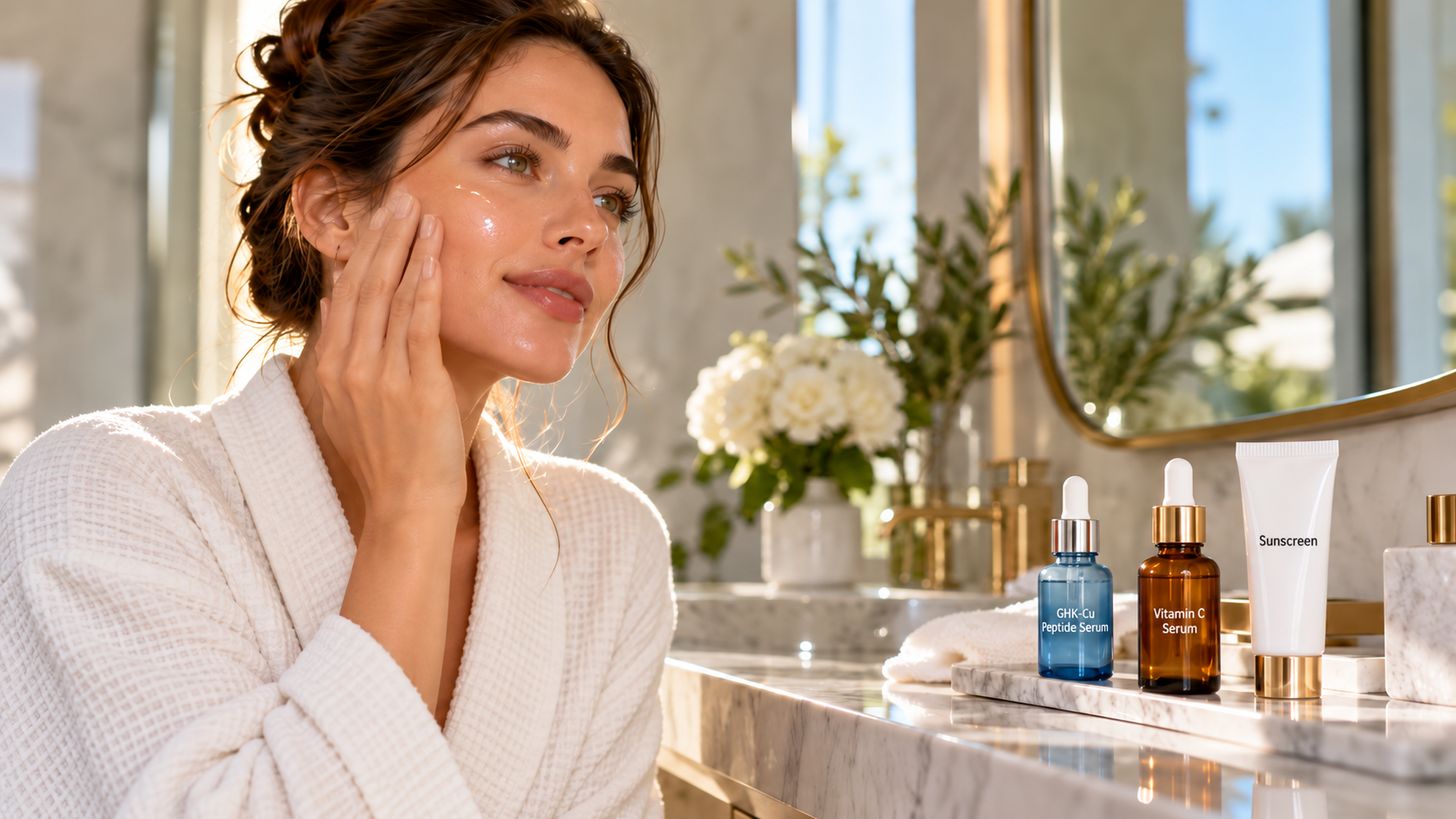
A GHK-Cu peptide serum generally goes after cleansing and before moisturizer.
Retinol and copper peptides can both fit into a routine, but alternating them may be easier for sensitive skin.
Strong vitamin C formulas are often simpler to use separately from GHK-Cu.
Broad-spectrum SPF should remain the final step of every morning routine.
Consistency and skin tolerance matter more than using several active ingredients at once.
GHK-Cu has become a familiar ingredient in skincare routines focused on firmness, texture and visible signs of aging. The bigger challenge is often deciding where it belongs alongside ingredients that are already well established, particularly retinol, vitamin C and sunscreen.
A good copper peptide routine does not need to involve a long list of products. The goal is to give each ingredient a clear place while keeping the skin comfortable enough for consistent use.
For anyone researching how to use GHK-Cu peptide, this guide focuses on topical facial skincare. Injectable GHK-Cu, dosing and medical administration are separate from cosmetic serum use and should not be approached through a skincare layering routine.
What Is GHK-Cu in Skincare?
GHK-Cu stands for glycyl-L-histidyl-L-lysine copper. In skincare ingredient lists, it may also appear as Copper Tripeptide-1.
It belongs to the broader family of copper peptides and is used in topical formulas designed to support the appearance of smoother, firmer and healthier-looking skin.
Research has explored GHK-Cu in relation to skin remodeling, collagen-associated pathways and repair processes.
For a deeper look at the skin-specific benefits, Drip Alchemy's guide on how GHK-Cu may support skin texture and tone explains that side of the peptide in more detail.
How to Use GHK-Cu Peptide in Your Skincare Routine
A lightweight GHK-Cu peptide serum for face will usually fit between cleansing and moisturizing.
The simplest order is cleanser, optional hydrating serum, GHK-Cu serum, moisturizer and sunscreen during the day. Product texture still matters, so thinner formulas usually come before heavier creams.
There is rarely a need to create complicated waiting periods between every product. Allow one layer to absorb enough that the next applies smoothly without pilling.
Following the directions of the specific serum is more useful than copying a routine based on a completely different formulation.
Should You Use GHK-Cu in the Morning or at Night?

Topical copper peptides can fit into either part of the day.
A simple morning routine can include GHK-Cu serum before moisturizer and SPF. Evening use may be more convenient for people who already have vitamin C or several other products in their morning routine.
The best time is ultimately the one that allows consistent use without making the rest of the routine unnecessarily complicated.
Can You Use GHK-Cu With Retinol?
Retinol and copper peptides GHK-Cu can both have a place in an anti-aging skincare routine.
The main issue is often skin tolerance rather than a simple rule that the two ingredients can never be used together. Retinol can cause dryness, peeling and irritation, especially when it is introduced too quickly.
People with sensitive skin may prefer to use GHK-Cu on one evening and retinol on another. This keeps the routine simple and makes reactions easier to identify.
CopperTheory similarly notes that alternating copper peptides and retinol can be a practical option instead of layering several strong actives together.
Prescription retinoids should always be used according to the prescribing clinician's directions.
Can You Use GHK-Cu With Vitamin C?
Vitamin C requires a little more attention because not all vitamin C formulas behave the same way.
Low-pH L-ascorbic acid products are often easier to separate from copper peptides instead of stacking both in the same routine. This can simplify the routine and reduce concerns around formulation compatibility.
A practical option is vitamin C in the morning followed by moisturizer and SPF, then GHK-Cu peptide serum in the evening before moisturizer.
Asterwood also recommends separating low-pH vitamin C and copper peptides by time of day as a straightforward routine strategy.
This does not mean every vitamin C derivative is automatically incompatible with every copper peptide serum.
Where Does SPF Fit in the Routine?
Sunscreen should remain the final skincare step every morning.
GHK-Cu is not a substitute for UV protection. A routine focused on skin texture, firmness and visible aging still needs consistent sun protection to support those goals.
UV exposure contributes to changes in collagen, pigmentation and overall skin texture. That makes sunscreen one of the most important supporting steps in an anti-aging routine.
Apply your serum and moisturizer first, then finish with a broad-spectrum sunscreen suited to your skin.
Can You Use GHK-Cu With Hyaluronic Acid?
Hyaluronic acid is usually one of the easiest ingredients to include alongside GHK-Cu.
Its main role is hydration rather than strong exfoliation or resurfacing, so it can help support skin comfort within an active routine.
When using separate products, a lightweight hyaluronic acid serum may come before the GHK-Cu serum, depending on texture and manufacturer directions.
Some copper peptide products already contain hydrating ingredients. In that case, adding another serum may not be necessary.
The routine should solve a skin need rather than simply include the maximum number of products.
Can You Use Niacinamide With GHK-Cu?
Niacinamide can also fit into many copper peptide routines.
Both ingredients are commonly found in formulas focused on barrier support, tone and overall skin appearance.
Older skincare advice sometimes treats active combinations as universally compatible or incompatible. In practice, finished formulations and individual tolerance matter considerably.
When introducing both at the same time, start gradually. If irritation develops, simplifying the routine makes it easier to identify which product is causing the problem.
What About AHAs and BHAs?
Exfoliating acids can make a skincare routine more demanding on the skin.
Glycolic acid, lactic acid and salicylic acid may increase dryness or irritation when combined with several other active products.
People with reactive skin may find it easier to keep exfoliating acids on separate evenings from GHK-Cu or retinol.
There is little benefit in forcing multiple strong actives into a single routine if the result is persistent dryness or barrier disruption.
Consistency with a comfortable routine is generally more useful than aggressive layering.
A Simple Morning GHK-Cu Routine
A basic morning routine can begin with a gentle cleanser, followed by GHK-Cu serum and moisturizer. Broad-spectrum SPF should finish the routine.
An additional hydrating product can be used when the skin needs it, but it is not automatically essential.
When a strong vitamin C serum is already part of the morning routine, keeping GHK-Cu for the evening may make the overall plan easier to manage.
The key is maintaining a routine that can be followed consistently rather than changing the order every day.
A Simple Evening GHK-Cu Routine
The evening routine can remain equally simple.
After cleansing, apply the GHK-Cu peptide serum for face and follow with moisturizer. For many people, that is enough.
Retinol users may choose alternate evenings if using both products together feels too irritating.
People already comfortable with active skincare may be able to incorporate both according to their individual product instructions.
The goal is not to use every active every night.
Common GHK-Cu Layering Mistakes
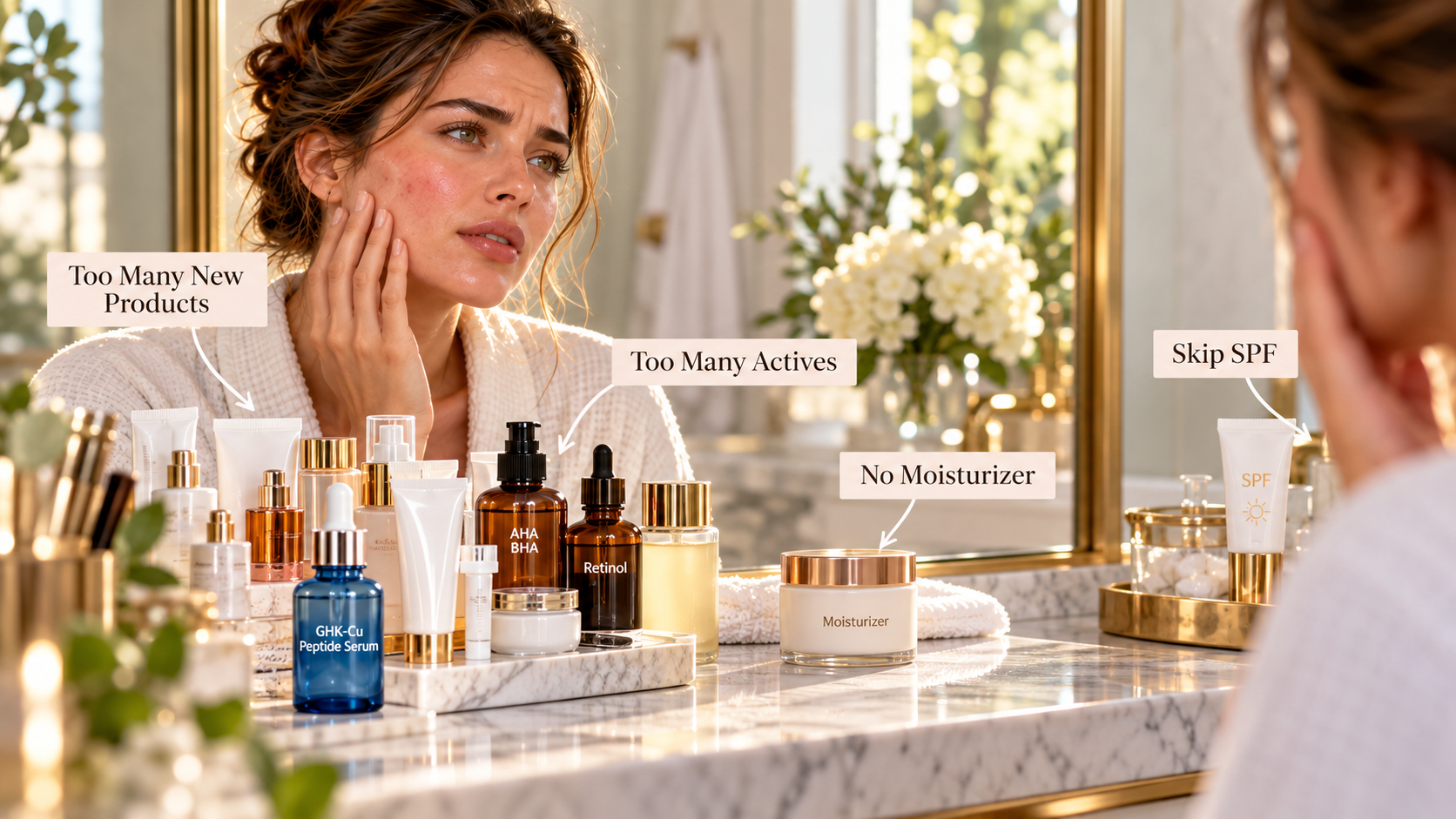
One common mistake is introducing several new products at once.
When the skin becomes irritated, it is then difficult to know whether the problem came from retinol, vitamin C, exfoliating acids, the peptide serum or the combination.
Another mistake is treating a serum as a replacement for moisturizer. Even when a serum feels hydrating, moisturizer can still play an important role in supporting the skin barrier.
Skipping sunscreen is another major issue. CopperTheory also identifies over-layering strong actives and inconsistent SPF use as common routine mistakes.
How Long Does GHK-Cu Take to Show Results?
GHK-Cu should not be approached as an overnight skincare treatment.
Changes in hydration or overall skin comfort may appear sooner, while visible changes in texture, firmness or fine lines generally require more consistent use.
Research and competitor discussions commonly evaluate topical copper peptides over weeks or months rather than a few days.
Formula quality, concentration, sun exposure, skin type and the rest of the routine can all affect how noticeable those changes are.
Drip Alchemy's broader guide to how peptides may benefit the skin provides useful context for understanding why different peptide products may produce different expectations.
Who Should Be Careful With GHK-Cu Skincare?
People with very sensitive, irritated or compromised skin should introduce new active ingredients carefully.
A known copper allergy or a medical condition involving copper metabolism should also be discussed with an appropriate healthcare professional before using copper-containing products.
Pregnancy and breastfeeding are additional situations where new active skincare ingredients are worth reviewing with a clinician.
Recent laser treatments, chemical peels or other procedures may temporarily change what the skin can tolerate.
For more individualized guidance, Drip Alchemy's medical team can help distinguish cosmetic skincare questions from concerns that need clinical evaluation.
Topical GHK-Cu and Peptide Therapy Are Different
A topical GHK-Cu peptide serum should not be treated as interchangeable with medically supervised peptide therapy.
A cosmetic serum is applied to the surface of the skin. Injectable or medically administered peptides involve different formulations, routes, dosing considerations and professional oversight.
Evidence from a topical skincare product cannot automatically be applied to injectable GHK-Cu.
CopperTheory also clearly separates cosmetic topical use from injectable preparation, dosing and medical administration.
Anyone considering a medically supervised peptide option should discuss that separately during a professional consultation rather than using skincare instructions as treatment guidance.
Frequently Asked Questions
How do you use GHK-Cu peptide on your face?
A topical GHK-Cu serum generally goes onto cleansed skin before moisturizer. The specific product directions should still guide use because texture, concentration and formulation can vary between brands.
Should GHK-Cu go before or after moisturizer?
Most lightweight GHK-Cu serums are applied before moisturizer. The moisturizer then helps support hydration and the skin barrier after the treatment step.
Can I use GHK-Cu peptide serum with retinol?
Both can fit into one skincare plan. People with sensitive skin may find alternating retinol and GHK-Cu on different evenings easier than using several active products at the same time.
Can I use GHK-Cu with vitamin C?
It depends on the vitamin C formula. Strong low-pH L-ascorbic acid products are often simpler to use separately, with vitamin C in the morning and GHK-Cu in the evening.
Can I use GHK-Cu in the morning?
Yes. A simple morning routine can include GHK-Cu serum, moisturizer and broad-spectrum SPF. If vitamin C already occupies the morning treatment step, GHK-Cu can be moved to the evening.
Do I need SPF when using copper peptides?
Yes. Copper peptides do not provide adequate UV protection. Sunscreen should remain the final morning step, particularly in routines designed to support the appearance of healthier, more even and firmer skin.
Can GHK-Cu be used every day?
Some topical GHK-Cu products are designed for daily use. Frequency should still follow the product directions and individual skin tolerance, particularly when retinol, exfoliating acids or other active ingredients are also being used.
Final Thoughts
A useful GHK-Cu skincare routine does not need to be complicated.
For most people, the foundation is cleansing, applying the peptide serum, moisturizing and finishing the morning routine with SPF. Retinol and vitamin C can still fit into the broader plan, but separating stronger actives may make the routine easier to tolerate.
The most important part of learning how to use GHK-Cu peptide is understanding the formulation you actually have rather than copying a rigid routine from another product.
Consistency, daily sun protection and realistic expectations matter more than aggressive layering. And when the conversation shifts from topical skincare to medically supervised peptide treatments, that should be treated as a separate clinical decision.
