
Can BOTOX Help Prevent Chronic Migraines?
If you live with chronic migraines, you already know the toll they take. Missed workdays, canceled plans, and the constant background anxiety of wondering when the next one will hit. For many people, over-the-counter medication and lifestyle changes only go so far. This is where Botox for migraines has become one of the more talked-about treatment options in recent years, and for good reason. It's the only botulinum toxin treatment specifically FDA-approved for chronic migraine prevention.
In this article, we'll walk through how Botox for migraines actually works, where it's injected, what results typically look like, and what to know about side effects before considering treatment.
What Counts as a Chronic Migraine?
Before discussing treatment, it helps to understand what qualifies as chronic migraine in the first place, since Botox isn't approved for occasional headaches. According to the American Migraine Foundation, chronic migraine is defined as experiencing headaches on 15 or more days per month for at least three months, with at least eight of those days meeting the criteria for migraine specifically, rather than a general tension headache.
This distinction matters. Botox is not approved or generally recommended for episodic migraines, meaning fewer than 15 headache days a month. It was developed and studied specifically for people whose migraines have become a near-constant part of daily life.
How Do Botox Injections Help Migraines?
The exact mechanism is still being studied, but researchers have identified several ways Botox appears to interrupt the migraine process at a neurological level. Botox, derived from botulinum toxin type A, works by blocking the release of certain neurotransmitters involved in pain signaling.
When injected into specific areas of the head and neck, Botox is believed to block the release of chemicals like calcitonin gene-related peptide, or CGRP, which plays a significant role in transmitting migraine pain signals. It also appears to reduce the sensitization of pain receptors around nerve endings, which can lower the frequency and intensity of migraine attacks over time.
Research published through the National Institutes of Health has shown that Botox treatment can meaningfully reduce the number of headache days per month in people with chronic migraine, particularly with repeated treatment cycles over time (National Institutes of Health, National Library of Medicine). It's worth noting that Botox is a preventive treatment, not something used to stop a migraine once it has already started.
Where Is Botox Injected for Migraine Headaches?
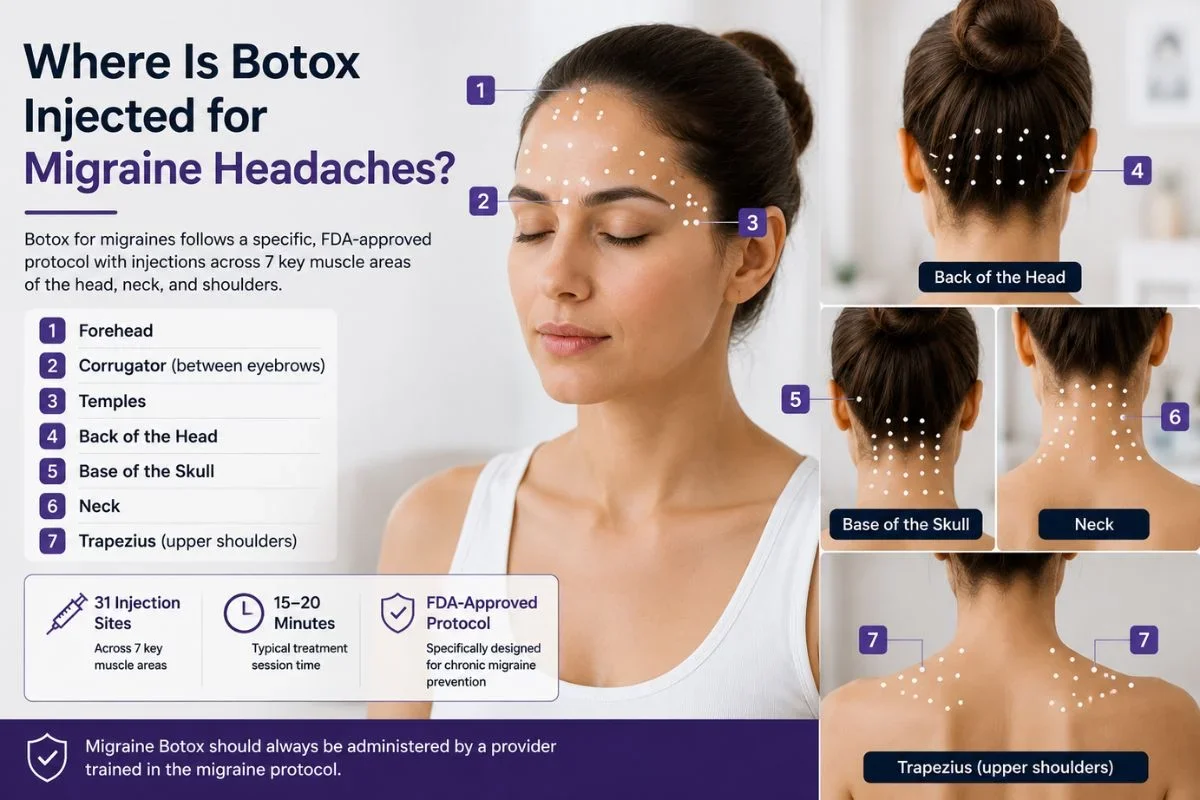
Medical infographic showing the FDA-approved Botox injection sites for chronic migraine treatment across the forehead, temples, back of the head, neck, and upper shoulders, illustrating the standard 31-injection protocol.
One of the most common questions people have before starting treatment is where exactly the injections go. Unlike cosmetic Botox, which typically targets a small handful of facial areas, migraine treatment follows a specific, standardized injection protocol developed and approved by the FDA.
The treatment typically involves injections across seven key muscle areas of the head and neck, including the forehead, temples, back of the head, base of the neck, and upper shoulders. In total, a full treatment session usually involves around 31 individual injection sites, using a small, fine needle for each. Most sessions take around 15 to 20 minutes from start to finish.
This is a significantly more comprehensive injection pattern than most people expect, which is exactly why migraine Botox should always be administered by a provider specifically trained in the migraine protocol, not just general cosmetic injection experience.
What Does Migraine Relief With Botox Actually Look Like?
It's important to set realistic expectations. Botox is not a cure for migraines, and it doesn't work for everyone. But for many people who qualify for treatment, the results can be significant.
Clinical trials, including the landmark PREEMPT trials that led to FDA approval, found that patients receiving Botox experienced a meaningful reduction in the number of headache days per month compared to those receiving a placebo. Many patients also reported improvements in overall quality of life, including reduced reliance on acute migraine medication.
Results are not usually immediate. Most people begin to notice a reduction in migraine frequency after their second treatment cycle, since Botox for migraines is administered as an ongoing treatment, typically every 12 weeks, rather than a one-time procedure. Consistency matters here. Skipping cycles or stopping treatment early can reduce the cumulative benefit that builds over multiple sessions.
Botox for Migraines: Side Effects to Know
Like any medical treatment, Botox for migraines does come with potential side effects, and it's worth understanding them clearly before starting.
The most commonly reported side effects include neck pain, injection site discomfort, and mild headache in the days following treatment. Some patients experience temporary muscle weakness near the injection sites or mild bruising that resolves within a few days. Less commonly, some people report eyelid drooping if the toxin migrates slightly from the intended injection area, which is one of many reasons injection technique and provider experience matter significantly.
More serious side effects are rare but can include difficulty swallowing or breathing problems if the toxin spreads beyond the treatment area, according to FDA prescribing information. This is why Botox for migraines should only be administered by a qualified, experienced medical provider who understands both the anatomy involved and how to recognize early signs of an adverse reaction.
Most side effects that do occur are mild and temporary, resolving within a week or two. Discussing your full medical history, including any neuromuscular conditions or medications you're taking, with your provider before treatment is an essential part of doing this safely.
Who Is a Good Candidate for Migraine Botox?
Botox for chronic migraine is generally considered for adults who meet the clinical definition of chronic migraine, have tried other preventive treatments without adequate relief, and don't have contraindications such as certain neuromuscular disorders or allergies to botulinum toxin products.
It's not typically the first line of treatment. Most providers will first explore lifestyle modifications, trigger identification, and oral preventive medications before recommending Botox, reserving it for cases where migraines are frequent enough and severe enough to significantly impact daily life.
A proper consultation is the best way to determine whether you're a good candidate, since migraine presentation varies significantly from person to person, and treatment should always be tailored to your specific pattern and history.
What to Expect During a Treatment Session
A typical Botox for migraines appointment starts with a review of your headache history and any changes since your last visit, followed by the injection series itself. Because the treatment involves multiple injection sites, providers usually work efficiently, and most patients describe the discomfort as brief, similar to a series of small pinches rather than significant pain.
There's minimal downtime. Most people return to their normal activities immediately after treatment, though providers typically recommend avoiding strenuous exercise and lying down flat for a few hours afterward to reduce the risk of the toxin migrating from the intended treatment area.
Why Provider Experience Matters So Much
Because migraine Botox involves a specific, multi-site injection protocol rather than a handful of cosmetic touch-ups, the experience and training of your provider plays a major role in both safety and results. An improperly administered treatment can lead to inconsistent relief or a higher likelihood of side effects like asymmetry or unwanted muscle weakness.
At Drip Alchemy NYC, our injections are performed by an experienced, credentialed medical team who understand both the clinical protocol behind migraine treatment and the precision it requires. You can learn more about the team administering treatment on our medical team page.
Frequently Asked Questions
How do Botox injections help migraines?
Botox is believed to block the release of pain-signaling chemicals like CGRP and reduce sensitization of nerve endings involved in migraine pain, which can lower the frequency and severity of chronic migraine attacks over repeated treatment cycles.
Where is Botox injected for migraine headaches?
Migraine Botox follows an FDA-approved protocol involving roughly 31 injections across seven areas of the head and neck, including the forehead, temples, back of the head, neck, and shoulders.
What are the common side effects of Botox for migraines?
The most common side effects include neck pain, injection site discomfort, temporary muscle weakness, and mild headache in the days following treatment. Serious side effects are rare but should always be discussed with your provider.
How long does it take to see migraine relief with Botox?
Most patients notice improvement after their second treatment cycle, since Botox for migraines is typically administered every 12 weeks as an ongoing preventive treatment rather than a single session.
Is Botox only for chronic migraines, or can it help occasional headaches too?
Botox is FDA-approved specifically for chronic migraine, defined as 15 or more headache days per month. It is not typically recommended or approved for episodic or occasional headaches.
A Note on Safety
The information in this article is for educational purposes and is not a substitute for professional medical advice. Individual results and side effects vary. Always consult a qualified healthcare provider to determine whether Botox for migraines is appropriate for your specific medical history.
Final Thoughts
Living with chronic migraines can feel like your calendar isn't fully your own. Botox for migraines won't work for everyone, and it isn't typically the first treatment tried. Still, for many people who qualify, it offers a real, clinically studied path toward fewer headache days and a better quality of life. Understanding how the treatment works, where it's injected, and what to realistically expect is the best foundation for deciding whether it's worth exploring with a qualified provider.
If you're ready to find out whether Botox for migraines could be right for you, book a consultation with our experienced medical team and get a treatment plan built around your specific migraine history.
