
What Really Happens During Your First Medical Weight Loss Consultation?
A medical weight loss consultation is a clinical appointment where a licensed provider reviews your health history, orders or reviews lab work, screens whether prescription options like GLP-1 injections are safe for you, and builds a personalized plan around your goals. It is not a sales pitch, and it is not a generic diet handout.
It is a medical evaluation, which is exactly why it starts with your body and your history rather than a one-size-fits-all program. If you have been curious but nervous about that first appointment, here is a clear, honest walkthrough of what actually happens and how to get the most out of it.
Most people arrive expecting to be weighed and handed a prescription. A good consultation for weight loss is more thorough than that, and that thoroughness is the point. If you want to see the medications and program a consultation leads into, Drip Alchemy's weight loss injections page lays out the options, but the consultation always comes first.
What Is a Medical Weight Loss Consultation?
A medical weight loss consultation is a professional assessment of your weight, metabolic health, and history, conducted by a licensed provider such as a nurse practitioner or physician. Unlike a commercial diet program, it treats excess weight as a medical condition with real physiological drivers, appetite hormones, insulin resistance, metabolism, and sleep among them, rather than a simple matter of willpower.
The goal of the appointment is twofold. First, to understand your full picture, why previous efforts may have stalled, what your health markers look like, and what is realistically achievable. Second, to determine whether a medically guided approach, which today often includes GLP-1 medications alongside nutrition and lifestyle support, is appropriate and safe for you. You leave with clarity and a plan, not just a number on a scale.
Why Your First Consultation Matters So Much
Your first medical weight loss consultation sets the foundation for everything that follows. Weight loss medications are powerful and effective, but they are not right for everyone, and the wrong plan without proper screening can mean avoidable side effects or missed underlying issues. This appointment is where a provider catches the things a website quiz never could: a thyroid problem, a medication interaction, or a history that makes a certain drug unsuitable.
It is also where expectations get set honestly. A responsible provider will talk about realistic timelines, the role of nutrition and muscle preservation, and the fact that these medications work best paired with lifestyle changes rather than as a standalone fix. That framing is what separates sustainable results from short-term ones.
What to Expect at a Weight Loss Consultation, Step by Step
Every clinic runs slightly differently, but a thorough consultation for weight loss generally moves through these stages.
1. Health history and goals. You will discuss your weight history, previous diets and what happened with them, current medications, family and personal medical history, and your actual goals. Be candid here. Details like past eating patterns or a family history of certain conditions directly shape what is safe and effective for you.
2. Measurements and a basic exam. Expect height, weight, BMI, and often blood pressure and waist measurements. These establish your starting point and help track progress objectively over time.
3. Lab work and bloodwork review. Baseline labs are a core part of a legitimate medical weight loss program, not an upsell. Common panels include A1C and fasting glucose to assess blood sugar, a comprehensive metabolic panel, a lipid panel, and thyroid markers when indicated. These labs confirm it is safe to proceed and can reveal issues like insulin resistance that inform your plan.
4. Eligibility and safety screening. Your provider checks whether prescription options are appropriate. GLP-1 therapy is generally suited to people with medical overweight or obesity, persistent cravings or "food noise," or metabolic goals like improving A1C, and it is not suitable for those who are pregnant, breastfeeding, or trying to conceive, or who have a personal or family history of medullary thyroid cancer or MEN2, a history of pancreatitis, certain severe GI conditions, or type 1 diabetes without specialist management. This screening protects you.
5. Discussing your options. Your provider explains the approaches that fit your profile, how they work, what results are realistic, and the trade-offs. This is a two-way conversation, not a prescription pushed across a desk.
6. Your personalized plan. You leave with a plan: which approach (if any) suits you, a starting dose and titration schedule if medication is appropriate, nutrition and lifestyle guidance, and a follow-up cadence so your provider can monitor progress and adjust.
The Weight Loss Injection Consultation: GLP-1 Specifics
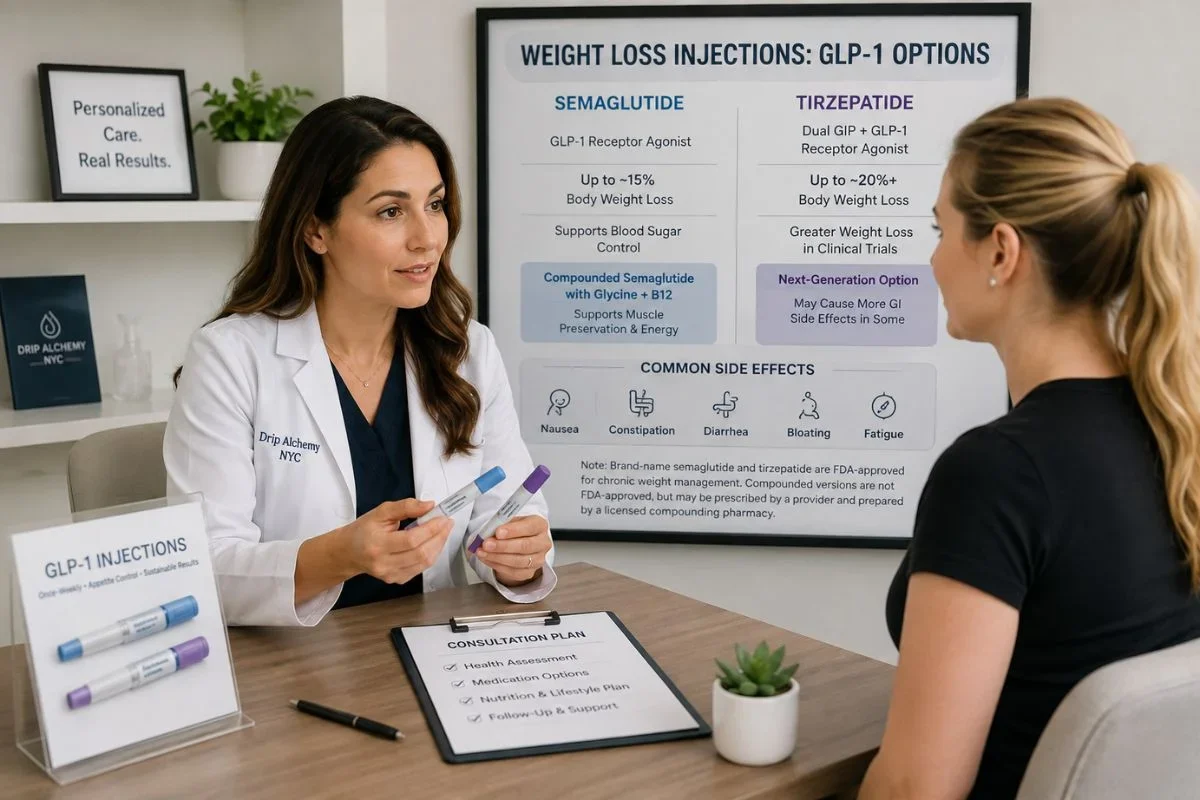
Medical weight loss consultation comparing semaglutide and tirzepatide GLP-1 injections, with a clinician discussing options and side effects.
If GLP-1 medications are on the table, your weight loss injection consultation will go deeper on the two leading options. Both are once-weekly injections that mimic the body's natural satiety hormones to reduce appetite and quiet food noise.
Semaglutide (the active ingredient in Ozempic and Wegovy) is a GLP-1 receptor agonist. In clinical use, patients may lose up to roughly 15 percent of body weight, and it also supports blood sugar control. At Drip Alchemy, it is offered as a compounded semaglutide with glycine and B12 to support muscle preservation and energy.
Tirzepatide (the active ingredient in Mounjaro and Zepbound) is a dual GLP-1 and GIP agonist, a next-generation option associated with greater weight loss, up to roughly 20 percent or more in trials. It tends to produce stronger results and, for some people, more GI side effects. A head-to-head trial published in the New England Journal of Medicine found tirzepatide produced greater average weight loss than semaglutide (about 20 percent versus 14 percent) over 72 weeks.
Your provider will also walk through side effects honestly. The most common are gastrointestinal issues, nausea, constipation, diarrhea, bloating, and mild fatigue, especially during the early dose-escalation phase, and they typically ease as your body adjusts.
An important accuracy point your provider should clarify: brand-name semaglutide and tirzepatide are FDA-approved for chronic weight management, while compounded versions are not FDA-approved, though they may be prescribed by a provider and prepared by a licensed compounding pharmacy. A trustworthy clinic tells you this plainly.
Questions Worth Asking During Your Consultation
A consultation is a two-way street. Good questions to bring include:
Based on my labs and history, which option do you recommend, and why?
What results are realistic for me, and over what timeline?
What side effects should I expect, and how will we manage them?
How does dosing and titration work, and how often will we follow up?
How do we protect muscle and nutrition while I lose weight?
What is the total monthly cost, and what does it include?
The quality of the answers tells you a lot about the quality of the clinic.
What Happens After Your First Consultation
If you are cleared to start, your provider typically begins you on a low dose and titrates upward gradually to minimize side effects. Many people notice reduced appetite and less food noise within the first week, steadier satiety over weeks two to four, and more noticeable body-composition changes from around weeks four to eight as the dose is optimized and paired with protein-forward nutrition and movement.
Progress from week eight onward tends to reflect consistency and follow-up rather than the medication alone.
Ongoing monitoring is part of the process, not an afterthought. Follow-up visits let your provider adjust your dose, check how you are tolerating treatment, and keep your plan aligned with your goals.
How to Prepare for Your Medical Weight Loss Consultation
A little preparation makes your first appointment far more productive:
Write down your weight history and what you have already tried.
List all medications and supplements you take.
Note your personal and family medical history, including any thyroid, pancreatic, or GI conditions.
Bring recent lab results if you have them.
Come with your goals and your questions written down.
Being organized helps your provider build a safer, more precise plan on day one. (One quick note for a different audience: if you are a provider researching how to start a weight loss clinic rather than a patient booking a visit, this same standard of history-taking, lab work, and honest screening is exactly what defines a responsible program.)
Your First Medical Weight Loss Consultation at Drip Alchemy NYC
At Drip Alchemy, medical weight loss begins with a proper consultation and lab review to assess eligibility before anything is prescribed. From there, the clinically supervised program offers compounded semaglutide or tirzepatide, each paired with glycine and B12, available in-clinic or at home with provider monitoring for precise dosing and managed side effects. The emphasis is on sustainable, medically guided results rather than crash dieting.
If you are ready to find out what a medically guided approach could look like for you, you can book your consultation directly, learn more about the weight loss injection program, or get in touch through the contact page with any questions first, or browse the clinic FAQs. You can also explore the full range of services on the Drip Alchemy homepage.
Frequently Asked Questions
What happens at a medical weight loss consultation?
A provider reviews your health history and goals, takes measurements like weight and BMI, reviews or orders baseline labs (such as A1C, glucose, a metabolic panel, and lipids), screens whether prescription options are safe for you, and builds a personalized plan. If medication is appropriate, you discuss dosing, side effects, and follow-up.
Do I need bloodwork before starting weight loss injections?
Yes. Baseline labs are a standard, important part of a medical weight loss program. They typically include A1C, fasting glucose, a comprehensive metabolic panel, a lipid panel, and thyroid markers when indicated to confirm it is safe for you to begin and to guide your plan.
How long does a first weight loss consultation take?
It varies by clinic, but a thorough first consultation is not rushed, since it covers your full history, measurements, lab review, eligibility screening, and a personalized plan. Plan for a focused appointment rather than a quick in-and-out visit.
What is the difference between semaglutide and tirzepatide?
Semaglutide (Ozempic, Wegovy) is a GLP-1 receptor agonist associated with up to about 15 percent body weight loss. Tirzepatide (Mounjaro, Zepbound) is a dual GLP-1 and GIP agonist associated with greater weight loss, up to about 20 percent or more, sometimes with more GI side effects. Your provider recommends based on your profile.
Who is not a good candidate for GLP-1 weight loss injections?
GLP-1 medications are generally not suitable for people who are pregnant, breastfeeding, or trying to conceive, or who have a personal or family history of medullary thyroid cancer or MEN2, a history of pancreatitis, certain severe GI conditions, or type 1 diabetes without specialist management. A consultation exists to screen for exactly these factors.
How much does a medical weight loss program cost?
Costs vary by medication and clinic. At Drip Alchemy, compounded semaglutide starts at $475 per month and tirzepatide at $650 per month, each including glycine and B12, with a required consultation and lab review to confirm eligibility before starting.
Does insurance cover medical weight loss injections?
Coverage varies widely. Some insurance plans cover brand-name GLP-1 medications for specific diagnoses, while compounded versions and cash-pay wellness programs are typically not billed to insurance. Because policies differ, the most reliable step is to ask the clinic directly what is included in the program price and to check your own plan's coverage for weight management medications.
